

Long-haired or short-haired Estrela Mountain Dog: which is the best for you?

Updated: Jun 22
Choosing an Estrela Mountain Dog should be a well-pondered decision based on several factors, such as your lifestyle, what you want from them, the region and climate where you live, the space they will live and the time you can dedicate to walking and caring for them. The choice between the long-haired or short-haired variety is one that requires reflection. Which one best suits your lifestyle and needs? This text will help you understand the differences, advantages and care requirements of each variety, to make the right choice.

General traits of the Estrela Mountain Dog
Before delving into the differences between the two varieties, it's important to know a little about the breed. The Estrela Mountain Dog is traditionally used for livestock protection in the mountains between the Serra da Estrela and Alto Douro regions. They're strong, resilient, healthy, large in size and robust in build, possessing an intrinsic protective instinct that develops towards the beings with which they grow up (people or animals). Their temperament is calm, yet vigilant and courageous; they're intelligent and, although they tends to be independent, they're easy to train, requiring only persistence. Careful with more delicate beings, such as children, the elderly, people with disabilities, and babies or small animals, they are potentially an excellent companion for families and those who enjoy outdoor activities. It is important, however, to emphasize that, like any dog, or like any person, they require being trained with balance and consistency.

Long and spectacular or short and practical?
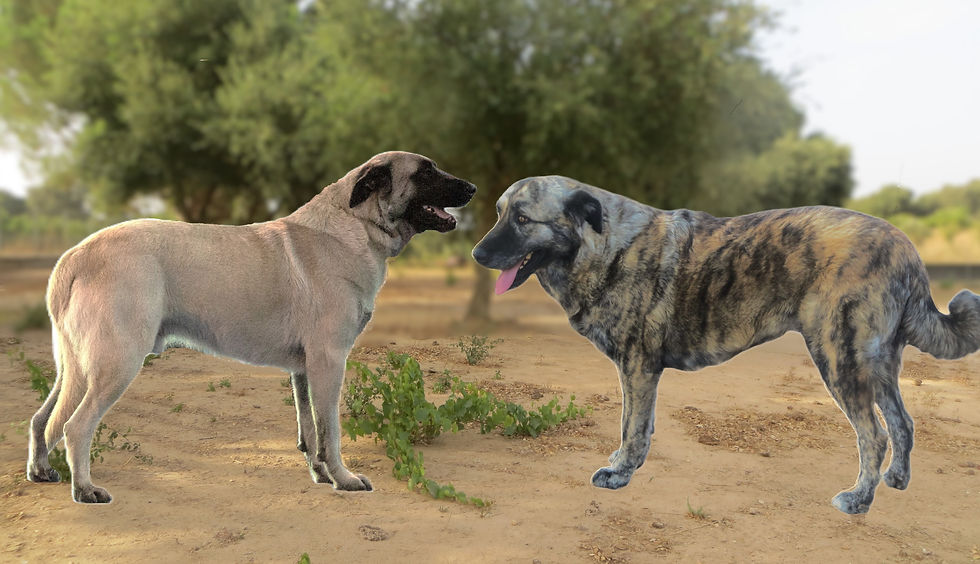
While most people still prefer the long-haired Estrela, whether because ghey are much better known and publicized or because of their imposing and majestic beauty, their voluminous and impressive coat, often soft, silky and shiny (although this trait is a degeneration of the original texture, which is coarse like goat hair), in recent years there has been a growing interest in the short-haired variety, due to the more practical handling of the coat and their better adaptation to a rural habitat with a lot of dry vegetation, which gets stuck and conceiled much more easily in the long hair than in the short one.
However, it wasn't always like this. A few decades ago, while the long-haired Estrela thrived and slowly began to spread to other countries, the short-haired one was in danger of extinction, having been preserved almost exclusively by livestock breeders and the occasional dedicated dog breeder, and driven by the action of the Grupo Lobo Association, which for more than 30 years has been placing puppies of this variety with shepherds to protect their flocks, while also helping to manage their reproduction and the preservation of the vaariety. Although now more stable and no longer at risk, it is still largely unknown to many Portuguese people, who only know the long-haired Estrela.

Spot the differences
Contrary to what some claim, the differences in temperament that may exist between specimens of one variety and another are not due to an intrinsic genetic trait related to coat length, but rather to factors such as individual temperament, training, or, more likely, the fact that many short-haired Estrelas come from working dog lines, selected for being wary to better fulfill their function. But not all are like that. When choosing a puppy, whatever the variety, it is important that the breeder helps you choose the most suitable one for the life they'll be provided. In both the short-haired and long-haired varieties, there are docile, calm, easy-to-handle specimens, and also others that are more wary or reserved, generally totally devoted to their family group (humans and/or animals) but intolerant of strangers.
The real difference between the varieties lies in the coat length, because both tend to have a more or less dense coat, with some variability between individuals, and the undercoat is also profuse. Typically not exceeding 5 cm in the case of short-haired dogs, and sometimes even shorter, the fur of long-haired variety reaches about 10 cm or more. Both should have thick fur, with a slightly coarse, goat-like texture, with some tendency to produce oiliness, a trait that helps to waterproof the coat and thus protect the animal against intense cold, rain and snow in the mountains.

Long-hair for cold climates, short-hair for hot climates?
Although this is the most common choice, any of the varieties can adapt to living in various climates. Long-haired dogs, if regularly or seasonally exposed to high temperatures (for example, those living in the Alentejo or Algarve, in Portugal, or in tropical or subtropical climates), tend to have their summer coat, after the undercoat sheds, become thinner than usual, even finer, which allows them to better withstand the heat. Similarly, short-haired Estrelas that inhabit very cold climates (such as those in Scandinavia or North America) usually acclimatize, developing a denser and more suitable coat.
More important than the length of the coat is its texture and the ability to produce a protective layer of fat, which makes rain and snow slide off the surface. Estrelas with fine, silky coats do not usually produce this grease and tend to become soaked when exposed to rain.
Necessary care
For long-haired dogs, weekly brushing is recommended to prevent tangles and knots behind the ears, on the tail, and on the fringes of the hind legs. It also helps maintain a clean and healthy coat and detect skin problems and the presence of foxtails and other dry vegetation.
Short-haired dogs hardly require brushing outside of the shedding periods.
During the shedding seasons (usually spring and autumn), brushing should be more frequent, preferably daily, for both breeds.
Bathing is only advisable if the dog is very dirty or gets wet in saltwater. In these cases, after a good wash with a neutral shampoo, a hair-dryer should be used to ensure the coat is completely dry – otherwise, the resulting odor will be even worse than before.
Final considerations
The choice between a long-haired or short-haired Estrela Mountain Dog depends on your lifestyle, environment and availability for grooming. The long coat is more beautiful and imposing but requires more maintenance time. The short coat is more practical and easier to care for.
I suggest that, when considering your decision, you think that if you opt for a short-haired PortuguseEstrela, you will be contributing to increase the population of this variety, which has only very recently begun to stabilize, promoting it and helping to preserve it as a Portuguese patrimony.
Comments